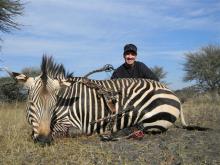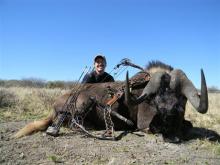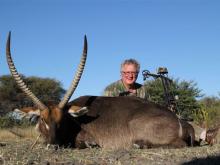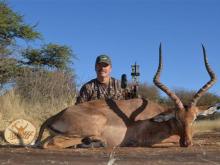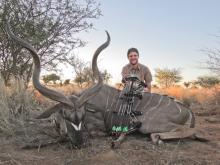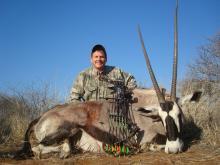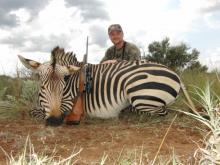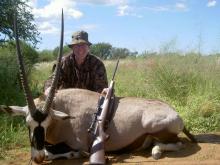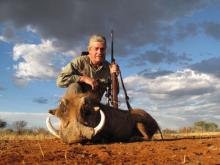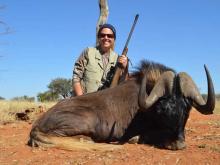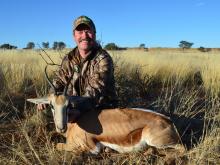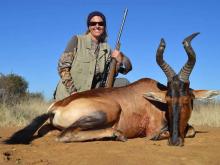
We
believe in Nature & Wildlife conservation and accept the challenge
for “the perfect shot”. We have a history of exceptional trophies
which have been hunted on our farm. Experience makes
the difference!
HUNTING:
Hunting season
The trophy
hunting season stretches from 1st February to 30th November.
Hunting Guides
Hunting shall be
conducted exclusively in the company of a registered hunting guide,
master hunting guide or professional hunter.
Bow hunting
Only hunting
guides/ master hunting guides/ professional hunters in possession of
a valid bow hunting license may conduct bow hunting and guide bow
hunters.
Hunting permits
A hunt shall only
commence if the Hunting Guide has obtained a valid hunting permit
(trophy hunting permit) from Nature Conservation prior to the start
of the hunt.
For Cheetah and Leopard an additional hunting permit has to be
obtained prior to the start of the hunt.
Only two animals
per species are allowed to be exported.
Firearms
Smallest caliber
7 mm.
Minimum energy (Eo - muzzle velocity): 1350 Joule for Springbuck,
Duiker, etc.
2700 Joule for Hartebeest, Wildebeest, Kudu, Oryx, Eland, etc.
5400 Joule for Buffalo, Elephant, Rhino, etc.
No solid point
cartridge is allowed to be used on antelope or any other species.
Handguns and automatic weapons are prohibited.
Smallest caliber
7 mm. We suggest caliber 300 Magnum, fitted with a 6x40 scope and 80
rounds of soft point, preferably Nossler partition ammunition.
Should you prefer to travel without weapons, we have a fine
selection of quality rifles and shotgun in camp for hire.
Bow hunting
Bow energy is specified as follows:
Small Game -25 ft/lb
Medium Game -40 ft/lb
Large Game -65 ft/lb.
Trophy Shipments and Taxidermy:
Clients trophies are usually delivered to the taxidermy and shipping
agent after the completion of the hunt, and should take about 30
days for cleaning and drying out properly. Shipping will take up to
6 weeks to reach their destination. The cost of taxidermy work in
Namibia is affordable, the quality of the workmanship is excellent,
and the end product very realistic as they are totally familiar with
the features and expressions of our local game. There is very little
difference in the weight, and therefore the cost of shipping raw or
mounted trophies. Current completion of mounts is about 12 months.
We
will gladly obtain quotations for you from our personal local
taxidermist.
Rifle Import Requirements
Hunters entering
Namibia with a rifle, must complete a temporary import permit
application form for all rifle's and/or ammunition in their
possession on arrival and the permit will be issued at the airport.
What to bring and wear:
Bring a pair of well broken in hunting shoes and 3 pairs of thick
woolen or cotton socks, with soft soles. Three pairs of Camo, dark
brown or green colors are recommended. We have sticky grass and
seeds so don't bring hunting clothes of wool. Pack a pair of
sneakers for camp use. Mornings and evenings are normally quite cool
to very cold so pack both a light and a heavy down jacket. A safari
hat and good quality sun glasses are essential.
Do not forget your video camera, and still camera's, as well as an
ample supply of film or large storage cards and batteries/chargers.
A good pair of 8x40 binoculars for the rifle hunter and a range
finder for the bow hunter.
How
to get to Namibia
Namibia's national carrier, Air Namibia, has regular direct flights
from Frankfurt to Windhoek International Airport, Hosea Kutako.
Please check the airline's website for possible changes in details.
South African Airways, South African Airways, in partnership with
Delta, offers a daily service from New York JFK, Washington Dulles
and Atlanta to Johannesburg and Cape Town, South Africa. S.A.A and
Air Namibia offer daily (2 hour) flights from Cape Town and
Johannesburg to Windhoek International. Please check the airline's
website for possible changes.
Economy:
Africa's most politically stable country with well-developed
infrastructure. Namibia is a democratic republic whose President and
Legislative members are elected by the general population.
Currency
The Namibian Dollar exchanges at exactly the same rate as the South
African Rand (ZAR). All major traveler's cheques, credit cards, and
US$ and Euro cash are accepted throughout Namibia. Use the currency
converter below to calculate current rates.
Languages
English is Namibia's official language, Afrikaans and German are
also commonly spoken.
Indigenous
languages: Oshivambo, Herero, Nama
Medical
No special health requirements are prescribed for entry into
Namibia. Malaria is not a threat in Agagia Hunting area, but it is
suggested that you refer to your personal physician for advice on
prophylactics and insect repellents. A comprehensive range of
international brand name medicine is stocked in camp and on the
hunting vehicles, but it is advised that you bring along the types
of medication that you regularly take, or may require. Medical
facilities, including excellent private hospitals and
internationally trained medical practitioners, specialists and
surgeons, are available in Windhoek which is 2 hours drive from the
camp. In case of extreme medical emergency an airlift service is
available. Tielman & Carin as well as the Professional Hunter's and
assistants, are all qualified in First Aid. |